
Most Washington homeowners assume that every contractor they hire holds a “license.” That assumption is understandable, but it’s also wrong in a very specific way that can cost you real money. Contractor registration in Washington is administered by the Department of Labor & Industries (L&I) under RCW Chapter 18.27, and the word “registration” is not just bureaucratic jargon. It’s a legal distinction that changes what you should ask for, what documents you should verify, and how protected you actually are if something goes wrong on your project.
Table of Contents
- How contractor licensing works in Washington
- Types of contractors: General, specialty, and trades
- How to verify a contractor’s credentials and avoid fraud
- Penalties and risks of hiring unregistered contractors
- Recent updates in Washington contractor law
- Why “licensed” means something different in Washington—and what savvy homeowners do differently
- Find a trustworthy, registered contractor for your next home project
- Frequently asked questions
Key Takeaways
| Point | Details |
|---|---|
| Registration, not licensing | In Washington, most contractors must register with L&I rather than obtain a traditional license. |
| Know contractor types | General, specialty, and trade contractors have different scopes and requirements for homeowners’ projects. |
| Always verify credentials | Check documentation, bond, and insurance using the official L&I Verify tool before hiring. |
| Risks of noncompliance | Hiring unregistered contractors exposes you to fines, legal challenges, and financial risk. |
| Stay informed on changes | Washington contractor laws and compliance programs update regularly, so check requirements before each project. |
How contractor licensing works in Washington
Washington’s system is genuinely different from most other states, and that difference trips up homeowners every single day. Here, the term “licensing” is reserved for specific trade professionals like electricians and plumbers. Everyone else, from the crew building your deck to the company replacing your roof, operates under a system called contractor registration.
Registration is required for any person or entity performing construction, alteration, repair, or improvement of structures for compensation exceeding $500. That threshold is low on purpose. It means that even a small repair job triggers the registration requirement for the contractor doing the work.
To register with L&I, a contractor must meet three core requirements:
- Surety bond: A financial guarantee that protects homeowners if the contractor fails to complete the work or causes damage.
- Liability insurance: Coverage for property damage or injuries that occur during the project.
- Application and fee: A completed registration application submitted to L&I, along with the applicable fee.
Once registered, the contractor receives a unique registration number. That number is your key to verifying their status before you sign anything. Here’s a quick comparison of the main contractor categories you’ll encounter in Washington:
| Contractor type | Regulated by | Key requirement | Scope of work |
|---|---|---|---|
| Registered general contractor | L&I (RCW 18.27) | Bond, insurance, registration | Broad construction, can subcontract |
| Registered specialty contractor | L&I (RCW 18.27) | Bond, insurance, registration | Specific trade (e.g., roofing, painting) |
| Licensed electrician | L&I (RCW 19.28) | Separate electrical license | Electrical work only |
| Licensed plumber | Dept. of Health | Separate plumber license | Plumbing work only |
Understanding which category your contractor falls into tells you exactly which documents to request and which agency to contact if something goes wrong. Make sure you’re checking the right box for the right type of work.
“Asking for a ‘license number’ in Washington is like asking for a ‘car registration’ when you actually need to see the driver’s license. Both matter, but they prove different things.”
Pro Tip: Always ask for the contractor’s L&I registration number specifically. Don’t accept a business license number or a general contractor’s card as a substitute. Those documents don’t confirm bond or insurance status, and they won’t help you if you need to file a complaint. You can also review legal contracting requirements to understand what a fully compliant contractor should bring to any project.
Types of contractors: General, specialty, and trades
Now that you understand registration, it’s important to know the legal boundaries for different types of contractors. Not every registered contractor can legally do every type of work, and hiring the wrong category for your project can create liability headaches you didn’t see coming.
General contractors can perform broad construction and subcontract work to specialty trades. Specialty contractors are limited to specific trades. Electrical and plumbing work require entirely separate licenses issued under different statutes. This matters because a registered general contractor cannot legally perform electrical work themselves without holding an electrical license. They must subcontract that portion to a licensed electrician.
Here’s how the contractor types break down in practical terms:
General contractors are the right choice when:
- You’re building an addition or remodeling multiple rooms at once.
- Your project involves multiple trades (framing, roofing, insulation, drywall) that need coordination.
- You want a single point of contact who manages subcontractors on your behalf.
Specialty contractors are the right choice when:
- You need a specific, defined scope of work like a new roof, a fresh coat of exterior paint, or a new deck.
- The project doesn’t require multiple trade disciplines working together.
- You want to hire directly and manage the project yourself.
Trade licensed professionals (electricians, plumbers) are required when:
- Any electrical wiring, panel work, or fixture installation is involved.
- Plumbing lines, water heaters, or drain systems are being modified or installed.
- Permits are pulled for this type of work, which inspectors will verify.
One important exception worth knowing: homeowners who perform work on their own home, without pay, are generally exempt from registration requirements. That means you can legally replace your own faucet or build your own fence without registering as a contractor. The moment you hire someone else to do it for compensation, that person must be registered.
| Contractor type | Can do whole-home projects? | Can subcontract? | Needs separate trade license? |
|---|---|---|---|
| General contractor | Yes | Yes | No (but must hire licensed trades) |
| Specialty contractor | Limited to their trade | Rarely | No |
| Licensed electrician | Electrical only | No | Yes (RCW 19.28) |
| Licensed plumber | Plumbing only | No | Yes |
How to verify a contractor’s credentials and avoid fraud
Once you know which contractor type you need, here’s how to protect yourself by vetting their credentials before any money changes hands.
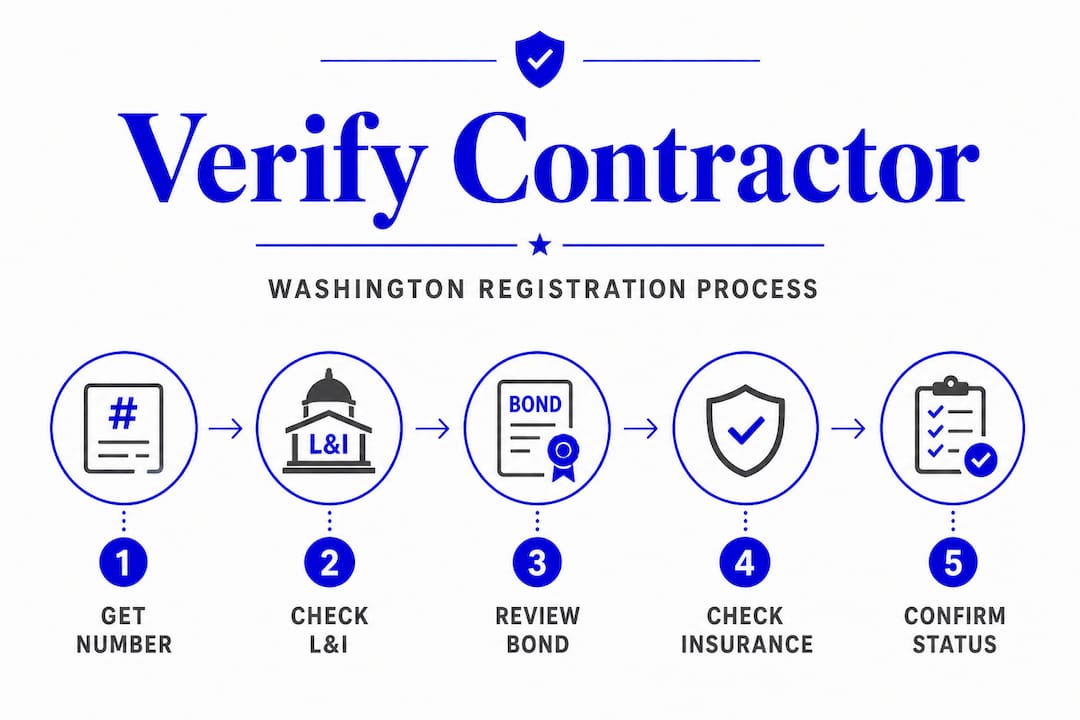
Verify registration status, bond, insurance, and complaints using L&I’s Verify tool at secure.lni.wa.gov/verify before hiring. This is a free, public tool that gives you real-time status on any registered contractor in Washington. It takes about two minutes and can save you thousands.
Here’s the step-by-step process:
- Go to secure.lni.wa.gov/verify and search by the contractor’s business name or registration number.
- Check registration status. It should say “active.” Expired or suspended registrations are red flags.
- Confirm bond status. Verify that the bond is current and note the bond amount. This is the maximum you could recover if the contractor abandons your project or causes damage.
- Confirm insurance status. Active liability insurance protects your property. No insurance means you bear the risk.
- Review complaint history. L&I records formal complaints. Multiple unresolved complaints are a serious warning sign.
- Request physical documentation. Never rely on screenshots a contractor sends you. Pull the information directly from L&I yourself.
One thing many homeowners overlook: bond amounts doubled in 2024 for better consumer protection, but those amounts can still change. Always check the current bond amount on L&I’s site rather than assuming what you read online is still accurate.
Common red flags to watch for:
- A contractor who can’t provide their L&I registration number immediately.
- Requests for large cash deposits before any work begins.
- Pressure to skip permits “to save money.”
- Prices dramatically lower than every other bid you received.
- No physical business address or only a P.O. box.
“A contractor who resists verification is telling you something important. Legitimate professionals welcome the check because it proves they’ve done the work to stay compliant.”
Pro Tip: Don’t skip the bond and insurance check even if the contractor comes highly recommended by a neighbor. Referrals are valuable, but registration status can lapse between the time your neighbor hired them and the time you do. Always verify current status yourself. You can also review contractor portfolios to evaluate the quality of completed work alongside their compliance documentation.
Penalties and risks of hiring unregistered contractors
Doing your homework before you hire isn’t just smart. It’s required by law, and avoiding it can have real, costly consequences for both you and the contractor.
Unregistered contracting is a gross misdemeanor under RCW 18.27.020, with fines up to $5,000. Beyond the criminal classification, unregistered contractors cannot file liens against your property, which sounds like a benefit until you realize it also means you have almost no legal recourse through the standard contractor complaint process if something goes wrong.
Here are the most common problems homeowners report after working with unregistered contractors:
- Work abandoned mid-project after a partial payment was collected.
- Structural defects discovered months later with no contractor available to fix them.
- Property damage during the project with no insurance to cover repairs.
- Permit failures because the contractor wasn’t legally authorized to pull permits.
- No bond to recover funds from, leaving homeowners out of pocket.
Even when you hire a registered contractor, it’s important to understand that L&I handles complaints and enforcement and bonds provide recovery only up to their stated limit. If your project costs $150,000 and the bond maximum is $12,000, you are not fully covered for the difference if things go wrong. This is why vetting the contractor’s reputation, references, and portfolio matters just as much as confirming registration.
The $5,000 fine reality: That maximum fine applies to the contractor, not to you as a homeowner. However, if you knowingly hire an unregistered contractor and something goes wrong, you may find yourself with limited legal options and no financial safety net. Courts have little sympathy for homeowners who skipped basic verification steps.
Recent updates in Washington contractor law
Contractor law isn’t static. Here are the latest changes that could affect your next project and why staying current matters more than ever.
Recent changes include a proposed Homeowner Recovery Program introduced through 2023 legislation, along with the adoption of electronic insurance submittal. These updates reflect a broader trend toward stronger consumer protections and more efficient compliance processes.
Key regulatory updates worth knowing:
- Homeowner Recovery Program: This proposed program would create a dedicated recovery fund for homeowners harmed by contractor fraud or abandonment. If enacted, it could provide an additional layer of financial protection beyond what bonds currently offer.
- Electronic insurance submittal: Contractors can now submit insurance documentation electronically to L&I, which speeds up the verification process and makes it easier to confirm that a contractor’s insurance is current.
- Bond amount increases: As noted earlier, bond requirements increased in 2024. This change was specifically designed to give homeowners more financial protection when things go wrong.
- Ongoing L&I enforcement updates: L&I periodically updates its enforcement priorities and complaint processes. Checking their website before starting any major project ensures you’re working with the most current information.
Why does staying current on these changes matter to you as a homeowner? Because requirements that were accurate when your neighbor hired their contractor two years ago may no longer apply today. Bond amounts, insurance minimums, and recovery options all evolve. A contractor who was fully compliant in 2022 may need to update their bond to remain compliant today.
Why “licensed” means something different in Washington—and what savvy homeowners do differently
Here’s the uncomfortable truth that most contractor guides won’t tell you directly: the confusion between “licensed” and “registered” isn’t just a homeowner problem. Real estate agents, property managers, and even some contractors themselves use these terms interchangeably, and that sloppiness creates real risk.
Washington uses “registered” for general and specialty contractors under RCW 18.27, which is entirely distinct from “licensed” for trades like electrical work under RCW 19.28. When a homeowner asks a contractor “are you licensed?” and the contractor says “yes,” both parties may be talking about completely different things. The contractor might mean they have a business license. The homeowner assumes that means full registration, bond, and insurance. Neither assumption is verified.
We’ve seen this play out in a very specific way: an out-of-state contractor arrives in Washington with valid registration from their home state, assumes it transfers, and starts taking on projects. It doesn’t transfer. Washington requires its own registration regardless of what credentials a contractor holds elsewhere. Homeowners who hired that contractor in good faith had no bond protection and no complaint pathway through L&I.
Savvy homeowners do three things differently. First, they ask specifically for the L&I registration number, not a “license.” Second, they verify that number themselves through the L&I Verify tool rather than trusting a card or a screenshot. Third, they look at local project portfolios to evaluate the contractor’s actual work quality alongside their compliance status. Registration tells you a contractor is legal. Their portfolio tells you whether they’re any good.
The terminology confusion persists because Washington is genuinely unusual. Most states call it licensing. Washington calls it registration. Until that changes, the burden falls on you as the homeowner to ask the right question.
Find a trustworthy, registered contractor for your next home project
If you want to skip the regulatory guesswork, here’s how to find a registered contractor you can trust.
At JDI Contracting, we maintain full registration, bonding, and insurance compliance with Washington’s L&I requirements, and we’ve done so for over 25 years. Our team serves homeowners across the Spokane region and into western Washington’s Snohomish and Skagit counties, and we bring the same rigorous standards to every project we take on.

Whether you need residential roofing services, complete renovation solutions, or professional siding installation, our team is ready to provide documentation of our registration status upfront, answer your verification questions directly, and deliver the quality craftsmanship that’s earned us our reputation across Washington. Contact us today for a quote and experience what working with a fully compliant, experienced contractor actually feels like.
Frequently asked questions
What is the difference between contractor registration and licensing in Washington?
In Washington, most contractors are required to register with L&I under RCW Chapter 18.27, not hold a license. Separate licenses are required only for specific trades like electrical and plumbing work.
Do all home improvement projects require hiring a registered contractor?
If the total cost exceeds $500 and the work is performed for compensation, registration is required for the contractor doing the work, with very limited exceptions for homeowners doing their own work.
How can I verify a contractor’s registration, bond, and insurance in Washington?
Use L&I’s Verify tool online at secure.lni.wa.gov/verify to check real-time registration status, bond, insurance coverage, and complaint history before you hire.
Are there penalties for hiring unregistered contractors in Washington?
Working as an unregistered contractor is a gross misdemeanor under RCW 18.27.020, with fines up to $5,000, and unregistered contractors cannot file liens or access the standard complaint process.
Has anything changed in contractor registration rules recently?
Yes. Recent legislative changes include a proposed Homeowner Recovery Program from 2023 and the adoption of electronic insurance submittal, making compliance verification faster and consumer protections stronger.
Recommended
- Home – JDI Contracting Group | General Contractor
- Roofing Solutions for a Durable Home – JDI Contracting Group | General Contractor
- Portfolio – JDI Contracting Group | General Contractor
- Maximizing Curb Appeal: Exterior Renovation Ideas for Your Home – JDI Contracting Group | General Contractor
- Texas homeowner’s checklist: smart tips for choosing contractors | BidWolf Blog